 Tyler House Leveling
 House Leveling in Tyler: What It Is and What It Costs
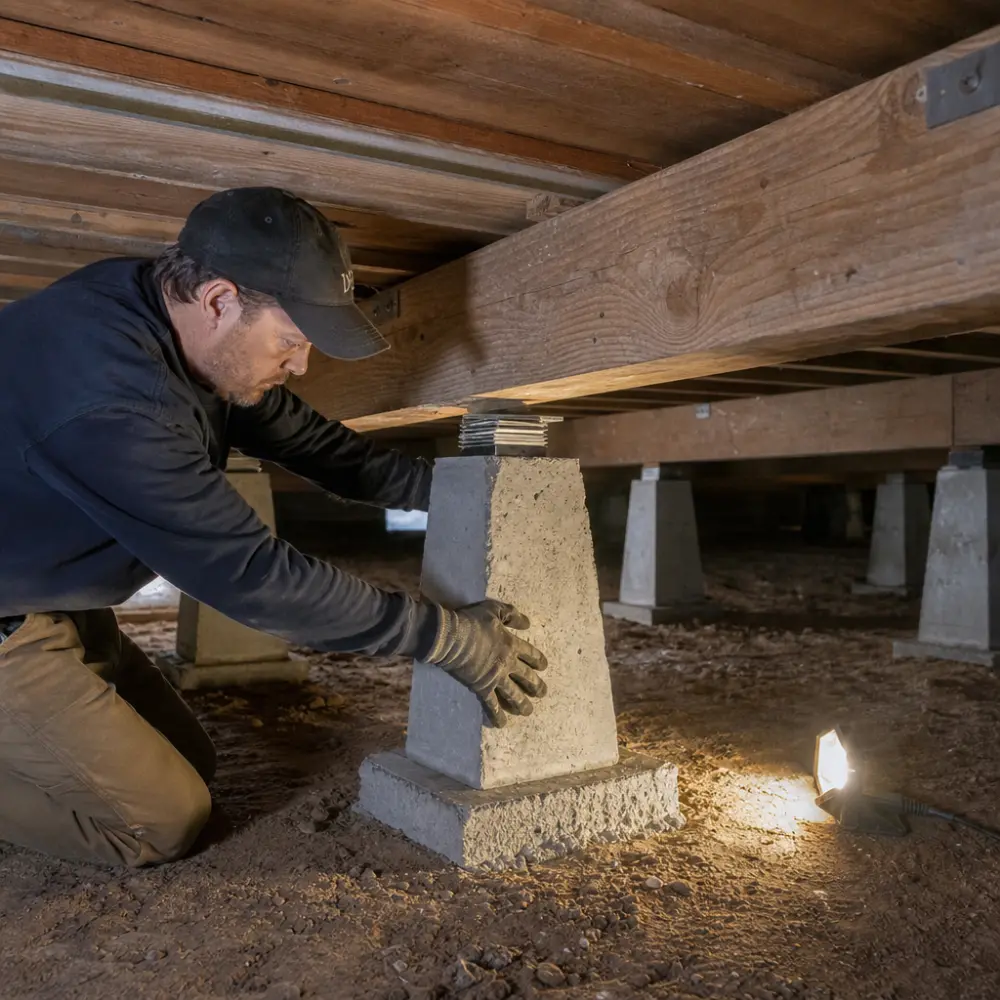
House leveling is the general call: something about the floor feels off (a slope, a bounce, a door that will not sit right) and you are not sure what is actually wrong yet. That is exactly what the free level check is for. An instrument reading of the floor, room by room, tells you whether you have real foundation movement, and if so, whether you have a pier and beam or a slab foundation, which changes everything about the fix and the price. Typical whole-house releveling runs $1,500 to $8,000; a single pier reset is $100 to $300.
Why “house leveling” covers two different jobs
Tyler’s housing stock splits cleanly by era and construction type, and the two need different repairs:
- Pre-1970 pier-and-beam homes, common in Tyler’s older neighborhoods including the Azalea and Brick Streets historic districts, sit on a system of concrete or masonry piers supporting a wood frame, with a crawlspace underneath. Releveling resets or rebuilds individual piers.
- Slab-on-grade homes, more common in newer East Texas subdivisions, have the structure poured directly on a concrete slab with no crawlspace. Slab repair uses pressed concrete pilings or steel push piers driven under the slab edge.
If you are not sure which one you have: foundation vents or any crawlspace access around the base of the house means pier and beam. A house that sits flush to the ground with no crawlspace at all is a slab.
What causes it here
Smith County’s own soil survey maps a Bowie-Cuthbert-Kirvin soil association across most of the ridges and divides Tyler is built on: a sandy surface over a clay-rich subsoil, 35 to 60 percent clay according to the official NRCS series descriptions, and the Kirvin series’ official type location is Smith County itself. That clay swells when it absorbs water and shrinks when it dries out. A Tyler summer (average highs well into the 90s with 91 days a year above 90 degrees) followed by a wetter fall runs that cycle every year, and it does not move evenly under an entire house. One corner sinks a little more than another, a pier settles into softened ground, and the frame or slab follows the ground rather than staying flat.
This soil is genuinely milder than the heavy Blackland Prairie clays around Dallas and Waco: Kirvin and Cuthbert are officially classed with a “semiactive” clay mineralogy, a milder shrink-swell classification than the highly expansive smectitic clay (Houston Black) that dominates the Blackland Prairie, which is one reason East Texas pier-and-beam homes are often maintained with periodic releveling rather than needing a full foundation rebuild. It still moves enough to matter, though, which is the whole reason this business exists here.
What a level check finds
- A room-by-room reading with a laser or water level, referenced against a stable point in the house, usually an interior pier or a point furthest from any known problem area.
- A map of which areas are low, and by how much: a difference of a quarter inch across a room is very different from two inches.
- On pier-and-beam homes, a direct inspection under the house: which piers are carrying load, which are loose or cracked, and whether the sill or any joists show rot or damage.
- On slab homes, an exterior and interior inspection: crack patterns, door and window function, and where the slab reads lowest.
- A written estimate covering what needs repair and the price, before any work is scheduled.
Typical pricing
| Situation | Typical range | See also |
|---|---|---|
| A few piers reset (pier and beam) | $400 to $1,200 | Shim and pier adjustment |
| Full-house pier and beam releveling | $1,500 to $8,000 | Pier and beam foundation repair |
| Slab lifted on pressed pilings | $4,000 to $15,000 | Slab foundation repair |
| Sill or joist rot found and repaired | $1,000 to $6,000+ | Sill plate and floor joist repair |
| Manufactured/mobile home | $450 to $1,400 | Mobile home leveling |
Full price tables, including per-pier and per-piling costs, are on the pricing page.
Signs it is time for a level check
- A floor that slopes noticeably, or you can set a ball down and watch it roll.
- Doors or windows that stick, will not latch, or have gotten progressively harder to close.
- Cracks above door or window frames, especially ones that keep growing.
- A soft or bouncy feeling in the middle of a room.
- A gap that has opened between the floor and the baseboard.
- Standing water or visible dampness in the crawlspace.
Each of these has its own page in the problems section with a check-this-first list and the likely cause, if you want to narrow it down before calling.
What happens after the check
If the reading comes back within normal tolerance, you hear that, not a pitch for work you do not need. If it finds real movement, you get a written estimate broken out by what is actually wrong: pier count and location for pier-and-beam homes, piling count for slab homes, and a separate line for any sill or joist damage found. Nothing is scheduled until you approve the number, and the number does not move afterward unless something changes once the crew is under the house, like rot that was hidden behind skirting.
Texas has no state contractor license for foundation repair on a site-built home, so ask any crew what license, registration, and insurance they actually carry, and get it in writing. Read more on the about page, check the FAQ, or send us what you are seeing and where the house is to get a level check scheduled in Tyler, Longview, Whitehouse, Lindale, Bullard, Flint, or Chandler.
Frequently Asked Questions
What exactly does 'house leveling' mean?
Bringing a foundation that has settled or shifted unevenly back to a flat, evenly supported state. On a pier-and-beam home that means resetting or rebuilding piers under the frame; on a slab it means lifting the slab back toward level with pressed pilings or steel push piers. The method depends entirely on which foundation type you have.
How do I know if I need leveling or something smaller?
A level check tells you. Some symptoms, a squeaky board, a door that sticks only in humid weather, are minor and do not need foundation work at all. Others, a floor with visible slope, doors that will not latch anywhere along the frame, cracks that keep growing, point to real movement. The check reads the floor with an instrument instead of guessing.
Is house leveling a one-time fix?
On the soil around Tyler, usually not for pier-and-beam homes. Smith County's clay-over-sand soil swells and shrinks across the seasons, and periodic releveling every few years is normal maintenance, not a sign the first job was done wrong. Slab repairs with pilings driven to a load-bearing stratum tend to be more permanent, since the pilings bypass the soil layer that moves the most.
What is the first step if I think my house needs leveling?
A free level check. The crew reads the floor room by room, and on a pier-and-beam home gets under the house to look at the piers, sill, and joists directly. You get a written estimate before anything else happens.