 Tyler House Leveling
 Shim and Pier Adjustment: The Maintenance Job
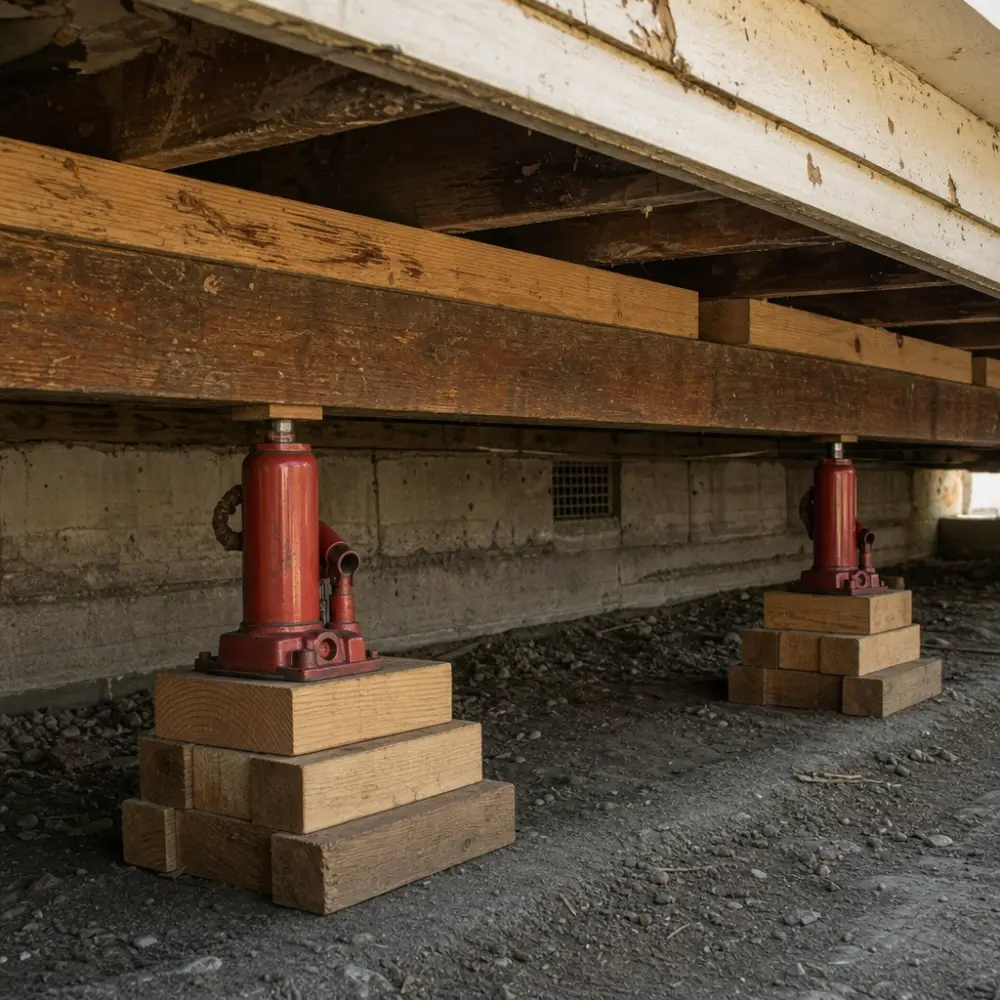
Shim and pier adjustment is the periodic maintenance job: resetting or rebuilding the handful of piers that have drifted out of level since the last check, without a full-house releveling. On Smith County’s clay-over-sand soil, this is the job most pier-and-beam homes in and around Tyler need again every few years, not a sign anything was done wrong the first time. A reset runs $100 to $300 per pier; a rebuild runs $300 to $1,000 per pier.
Reset versus rebuild, and why it matters for the price
Reshimming is for a pier that is still structurally sound (solid blocks, intact cap, no rot) but has drifted out of level because the beam settled slightly or the pier itself shifted a small amount. The crew adds or adjusts hardwood shims between the pier cap and the beam until it reads level again. This is the faster, cheaper repair, $100 to $300 per pier.
Rebuilding is for a pier that has actually failed: a crushed or cracked concrete block, a rotted wood cap, or a pier that sank into softened soil and needs a wider footing to carry the load properly. The crew removes what is damaged and rebuilds the pier with new material before shimming it to level. This runs $300 to $1,000 per pier.
There is a real limit here too: building standards cap how tall a shim stack is allowed to be on top of a pier before it stops being a stable repair. A pier that would need a stack taller than that limit gets rebuilt instead of shimmed, even though shimming looks like the cheaper option on paper, because a tall, loose shim stack is not a repair that holds up.
What triggers this job
- A routine check on a home that has not been level-checked in a few years, especially after a stretch of unusually wet or unusually dry weather.
- A specific new symptom: a door that started sticking, a new gap at a baseboard, a crack that appeared above a door frame. See the problems section for symptom-specific pages, including sloping or uneven floors and doors that stick or won’t latch.
- Following up after a slow leak or drainage problem was fixed, since the soil under the affected piers may need a season to fully dry and settle before a final adjustment makes sense.
How the visit works
- Level check first, mapping which piers (if any) are out and by how much. Full detail on the foundation inspection and level survey page.
- Crawlspace inspection of the specific piers flagged, checking whether each is a reshim or a rebuild.
- The work itself, usually completed the same visit for a small number of piers. Hydraulic jacks on solid cribbing lift the frame at each pier just enough to do the work, never held on the jack alone once the repair is in place.
- Re-check. The adjusted piers get re-shot to confirm the fix held and the surrounding floor reads level.
Pricing summary
| Job | Typical range | When it applies |
|---|---|---|
| Reshim a pier | $100 to $300 | Pier is sound, just shifted |
| Rebuild a pier | $300 to $1,000 | Cracked block, rotted cap, or sunk into soft soil |
| Small job, several piers | $400 to $1,500 | A section of the house, not the whole frame |
| Full-house releveling | $1,500 to $8,000 | See pier and beam foundation repair |
Full price tables are on the pricing page.
Why this is a recurring job here, not a one-time fix
Smith County’s soil survey maps a Bowie-Cuthbert-Kirvin association across most of the ground Tyler is built on, a sandy surface over a subsoil running 35 to 60 percent clay by the official series descriptions. That clay swells with moisture and shrinks as it dries, and the seasonal swing between a hot, dry Tyler summer and a wetter fall repeats every year. A pier that reads level today can be a quarter inch off in a year or two as the ground under it goes through another cycle. Periodic shim and pier adjustment is how a pier-and-beam house stays ahead of that, catching small drift before it becomes a full-house releveling job.
When it is not enough
If a level check finds that most of the house, not just a section, has drifted out of level, or that several piers have failed rather than just shifted, that points to pier and beam foundation repair instead. If rot is found at the sill or joists during the crawlspace inspection, that is a separate repair; see sill plate and floor joist repair. Either way, you get a straight answer about which situation you are actually in before any work is scheduled.
Have a specific symptom, or just think it has been a while since the house was checked? A free level check is the place to start, covering Tyler, Longview, Whitehouse, Lindale, Bullard, Flint, and Chandler.
Frequently Asked Questions
What is the difference between this and full pier and beam foundation repair?
Scale. Shim and pier adjustment is the smaller, more routine version, resetting or rebuilding a handful of piers that have drifted since the last check. A full pier and beam foundation repair job is what you call it when many piers across the house are out and the whole frame needs bringing back to level at once.
How much does resetting one pier cost?
$100 to $300 for a pier that only needs reshimming, meaning it is structurally sound but has shifted slightly. A pier that needs rebuilding, because a block cracked, a cap rotted, or it sank into soft soil, runs $300 to $1,000.
How do I know if I just need a couple piers adjusted or a bigger job?
The level check tells you. If only a corner or a small section of the house reads out of level, and the rest of the floor is stable, that usually points to a small adjustment. Widespread unevenness across most of the house points to a bigger job.
Is there a limit to how much shim material can go under a pier?
Yes. Building standards limit how tall a shim stack can be on top of a pier before it is considered unstable. A pier that would need a tall stack of shims to reach level gets rebuilt instead of shimmed, which is a judgment call the crew makes on site, not one made from a phone estimate.